Sand Density Chart
Sand density plays an important role in construction, landscaping, paving, and material estimation. Different types of sand have different weights depending on moisture content, particle size, and compaction. This guide provides a practical sand density chart and explains how density affects project planning and material calculations.
What Is Sand Density?
Sand density refers to the amount of weight contained within a specific volume of sand. It is commonly expressed in pounds per cubic foot (lb/ft³), kilograms per cubic meter (kg/m³), or tons per cubic yard. Understanding density helps estimate transportation requirements, project costs, and total material weight.
Material Estimation
Helps determine the total amount of sand needed for a project.
Weight Calculations
Makes it easier to estimate truckloads and delivery requirements.
Project Planning
Supports accurate budgeting and scheduling for construction projects.
Cost Management
Prevents under-ordering or over-ordering bulk sand materials.
Sand Density Chart
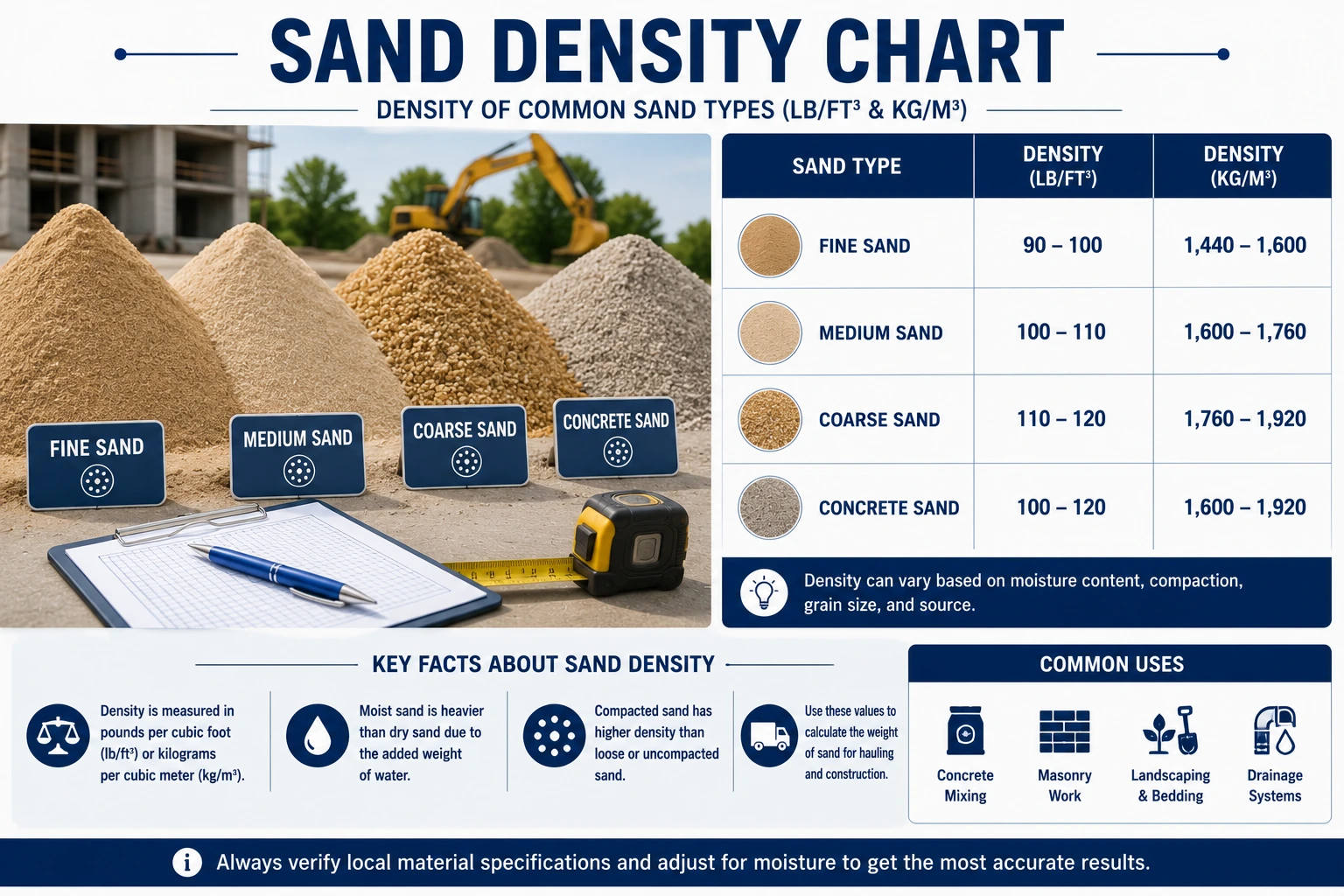
The following chart shows typical density values for common types of sand. Actual densities may vary slightly depending on moisture levels and supplier specifications.
| Sand Type | lb/ft³ | kg/m³ | Tons per Cubic Yard |
|---|---|---|---|
| Dry Sand | 100 | 1600 | 1.35 |
| Damp Sand | 110 | 1760 | 1.48 |
| Wet Sand | 120 | 1920 | 1.62 |
| Mason Sand | 105 | 1680 | 1.42 |
| Concrete Sand | 108 | 1730 | 1.46 |
| Play Sand | 100 | 1600 | 1.35 |
| Fill Sand | 95 | 1520 | 1.28 |
Common Sand Types and Their Uses
Different types of sand are designed for different construction and landscaping applications.
Mason Sand
Commonly used for mortar mixes, masonry projects, paver joints, and decorative landscaping applications.
Concrete Sand
Frequently used in concrete production, paver bases, drainage systems, and construction projects.
Play Sand
A cleaned and screened sand often used in sandboxes, playgrounds, and recreational areas.
Fill Sand
Commonly used for grading, leveling, backfilling, and site preparation work.
Sand Weight Example
The example below demonstrates how density can be used to estimate the total weight of sand required for a project.
Example Calculation
- Sand Volume: 5 Cubic Yards
- Density: 1.35 Tons per Cubic Yard
- Formula: Volume × Density
- Result: 5 × 1.35 = 6.75 Tons
Why Sand Density Changes
Sand density is not always constant. Several factors can affect the weight of sand and cause density values to vary between projects and suppliers.
Moisture Content
Wet sand weighs significantly more than dry sand because water fills the spaces between sand particles.
Particle Size
Fine sand and coarse sand pack differently, resulting in different density values.
Compaction
Compacted sand contains less air space and therefore weighs more per unit volume.
Mineral Composition
Different minerals have different densities, which can slightly change overall sand weight.
Common Sand Density Mistakes
Understanding density helps avoid common estimation errors when ordering bulk sand.
Ignoring Moisture
Wet sand can weigh much more than dry sand, leading to inaccurate estimates.
Using Generic Density Values
Different sand products may have different density characteristics.
Confusing Volume and Weight
Cubic yards measure volume, while tons measure weight. Both are important for accurate ordering.
Ignoring Compaction
Compacted sand often weighs more than loose sand occupying the same volume.
Need an Exact Sand Estimate?
Density charts provide useful averages, but every project is different. Use our Sand Calculator to calculate cubic yards, cubic feet, cubic meters, and estimated sand weight instantly.
Use Sand CalculatorFrequently Asked Questions
Why does wet sand weigh more than dry sand?
Water increases the total mass of sand, making wet sand significantly heavier than dry sand.
Does compacted sand weigh more than loose sand?
Yes. Compacted sand contains less air space and generally has a higher density than loose sand.
Which sand type is best for pavers?
Concrete sand and mason sand are commonly used for paver bases and installation projects.
Can sand density vary between suppliers?
Yes. Density may vary depending on moisture levels, particle size, and the source of the material.
Why is sand sold by both weight and volume?
Some suppliers sell sand by cubic yard, while others sell by ton. Both measurements help estimate material requirements.
What affects sand density the most?
Moisture content is usually the biggest factor affecting sand density and weight.
Is beach sand heavier than play sand?
It can be, depending on mineral composition, moisture content, and particle characteristics.
How accurate are sand density charts?
Density charts provide reliable average values, but actual densities may vary slightly between suppliers and conditions.
Does sand density change after rainfall?
Yes. Rainfall increases moisture content, which increases the weight and density of sand.
What unit is commonly used for bulk sand deliveries?
Bulk sand is commonly sold by cubic yards or tons, depending on the supplier and region.