How Many Bags of Concrete Make One Cubic Yard?
Whether you’re pouring a concrete slab, building a patio, setting fence posts, or installing footings, one question often comes up before purchasing materials: how many bags of concrete make one cubic yard? Knowing the answer helps you buy the correct amount of concrete, stay within budget, and avoid unnecessary trips to the hardware store.
Concrete is available in two common forms. For smaller DIY projects, it’s usually purchased in pre-mixed bags weighing 40, 50, 60, or 80 pounds. Larger projects are often supplied as ready-mix concrete and delivered by truck in cubic yards. Understanding how these bag sizes convert to cubic yards allows you to estimate material requirements accurately.
In this guide, you’ll learn how many bags of each size equal one cubic yard, how to calculate the number of bags needed for your project, when ready-mix concrete is a better option, and practical tips to reduce waste.
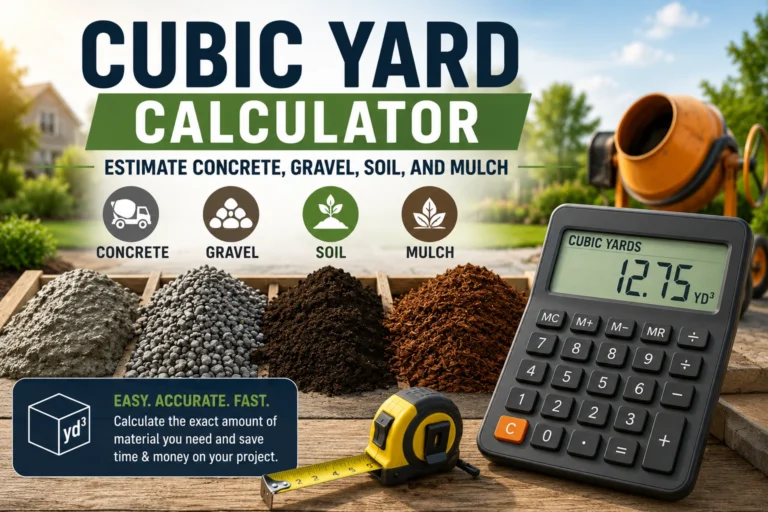
Need an instant estimate? Use our Concrete Calculator to calculate the exact amount of concrete required for your project.
What Is One Cubic Yard of Concrete?
Before calculating concrete bags, it’s important to understand what a cubic yard actually represents.
A cubic yard is a unit of volume commonly used in construction and landscaping.
One cubic yard equals:
| Measurement | Equivalent |
| Cubic Feet | 27 cu ft |
| Cubic Inches | 46,656 cu in |
| Cubic Meters | 0.7646 m³ |
Ready-mix concrete suppliers almost always sell concrete by the cubic yard, while home improvement stores typically sell bagged concrete.
Because each bag produces only a fraction of a cubic yard, multiple bags are required to equal one cubic yard of finished concrete.
How Much Concrete Does One Bag Produce?
The amount of concrete produced depends on the bag’s weight.
Larger bags yield more concrete, meaning fewer bags are required to complete the same project.
The table below shows the approximate yield of common bag sizes.
| Bag Size | Approximate Yield |
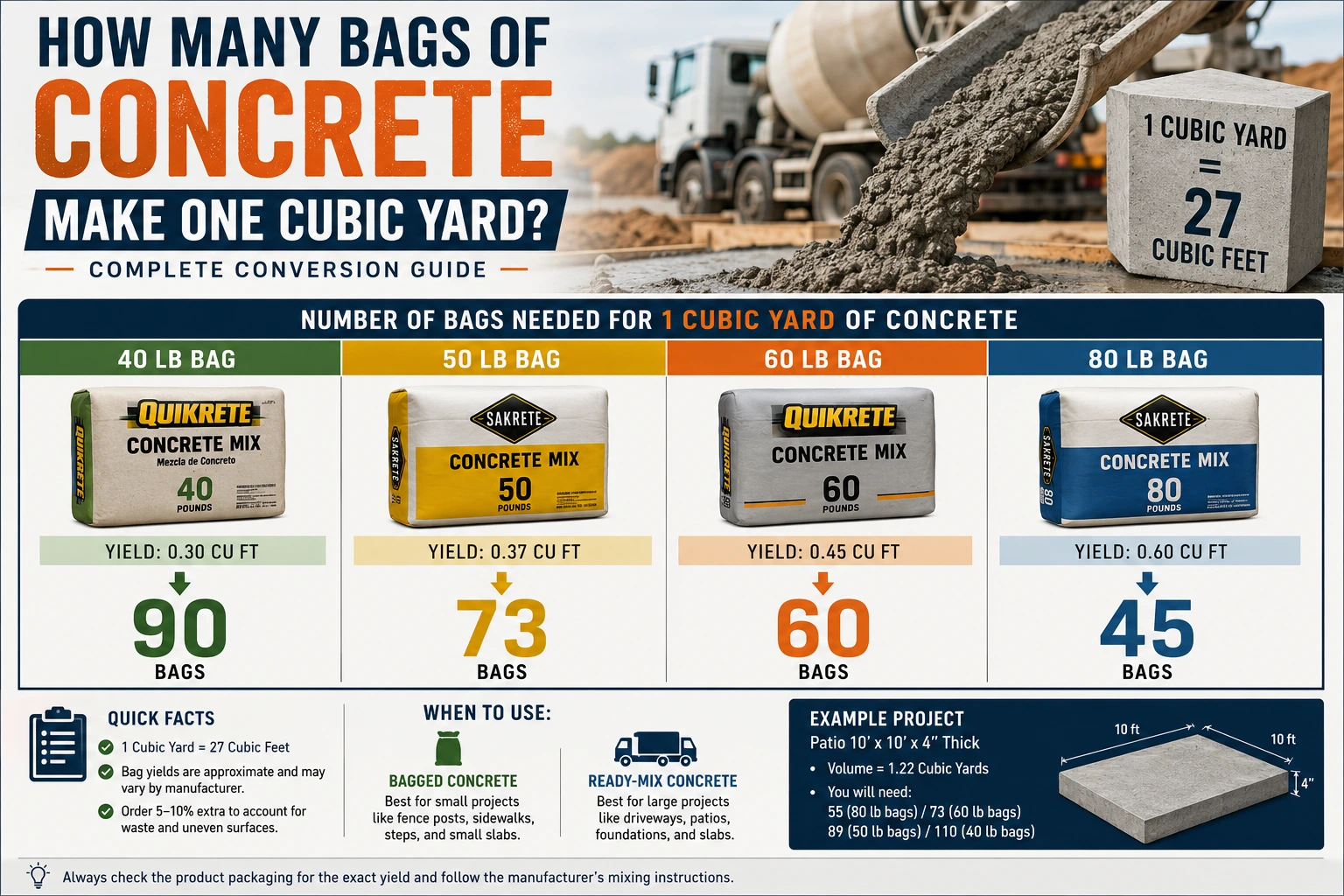
| 40 lb | 0.30 cubic feet |
| 50 lb | 0.37 cubic feet |
| 60 lb | 0.45 cubic feet |
| 80 lb | 0.60 cubic feet |
These yields may vary slightly between manufacturers, so always check the packaging for the exact coverage.
How Many Bags of Concrete Make One Cubic Yard?
Since one cubic yard contains 27 cubic feet, you can determine the required number of bags by dividing 27 by the yield of each bag.
The following chart provides the most commonly accepted estimates.
| Bag Size | Bags Per Cubic Yard |
| 40 lb | 90 bags |
| 50 lb | 73 bags |
| 60 lb | 60 bags |
| 80 lb | 45 bags |
These numbers are rounded to the nearest whole bag because purchasing partial bags isn’t possible.
For example, if your calculation shows that you need 44.2 bags of 80-pound concrete, you should purchase 45 bags.
Why Bag Size Matters
Many people assume that buying smaller bags is cheaper because the price per bag is lower. In reality, the total project cost often depends on the number of bags required.
An 80-pound bag produces approximately twice as much concrete as a 40-pound bag, meaning you’ll need far fewer bags to complete the same project.
However, larger bags are heavier to lift and mix. If you’re working alone or have limited lifting ability, smaller bags may be easier to handle even though you’ll need more of them.
Choosing the right bag size depends on your budget, physical ability, and project size.
Example: Calculating Concrete Bags for a Patio
Imagine you’re building a small concrete patio measuring:
- Length: 10 feet
- Width: 10 feet
- Thickness: 4 inches
First, convert the thickness into feet.
4 inches ÷ 12 = 0.33 feet
Now calculate the total volume.
10 × 10 × 0.33 = 33 cubic feet
Convert cubic feet into cubic yards.
33 ÷ 27 = 1.22 cubic yards
Using the conversion chart:
- 80 lb bags: approximately 55 bags
- 60 lb bags: approximately 73 bags
- 50 lb bags: approximately 89 bags
- 40 lb bags: approximately 110 bags
For a project of this size, many contractors would recommend ordering ready-mix concrete instead of mixing dozens of individual bags.
When Should You Use Bagged Concrete?
Bagged concrete works best for smaller projects where ordering a ready-mix truck isn’t practical.
Examples include:
- Fence posts
- Mailbox posts
- Small patios
- Walkway repairs
- Garden edging
- Steps
- Concrete pads for sheds
- Basketball hoop bases
These projects usually require less than one cubic yard of concrete, making bagged concrete a convenient option.
When Is Ready-Mix Concrete a Better Choice?
Although bagged concrete is convenient for smaller jobs, it isn’t always the most practical option. As your project grows larger, mixing dozens of individual bags becomes time-consuming, physically demanding, and often more expensive than ordering ready-mix concrete.
Most contractors recommend switching to ready-mix concrete for projects requiring one cubic yard or more. A ready-mix truck delivers freshly mixed concrete directly to your job site, ensuring a consistent mix while eliminating the need to manually mix dozens of bags.
Ready-mix concrete is commonly used for:
- House foundations
- Large patios
- Driveways
- Garage floors
- Sidewalks
- Large retaining walls
- Commercial construction
If your calculations show you’ll need more than 45 bags of 80-pound concrete, it’s worth requesting a quote for ready-mix concrete before making a purchase.
Bagged Concrete vs Ready-Mix Concrete
Both options have their advantages, and the right choice depends on your project’s size and budget.
| Feature | Bagged Concrete | Ready-Mix Concrete |
| Best For | Small DIY projects | Large construction projects |
| Sold By | Individual bags | Cubic yards |
| Mixing | Manual | Delivered pre-mixed |
| Labor Required | High | Low |
| Consistency | Depends on mixing | Professionally mixed |
| Cost for Large Jobs | Higher | Usually lower |
| Waste | Minimal for small jobs | May include delivery minimums |
For small repairs, bagged concrete is usually the most economical choice. For larger pours, ready-mix concrete often saves both time and money.
How to Calculate the Number of Concrete Bags You Need
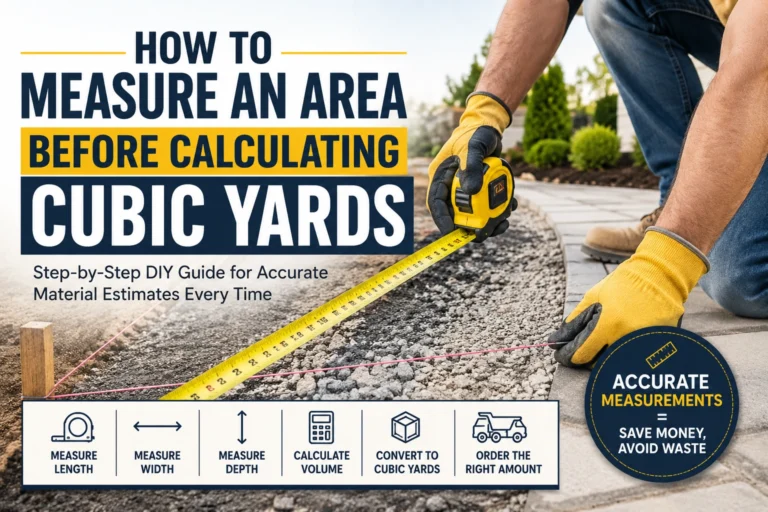
The easiest way to estimate concrete bags is to calculate the total project volume first and then convert that volume into the appropriate number of bags.
The formula is:
Concrete Volume = Length × Width × Thickness
Once you know the total volume in cubic feet, divide it by the yield of your chosen bag size.
For example, suppose your project requires 18 cubic feet of concrete.
If you’re using 80-pound bags, which produce approximately 0.60 cubic feet each, the calculation is:
18 ÷ 0.60 = 30 bags
If you’re using 60-pound bags, the calculation becomes:
18 ÷ 0.45 = 40 bags
This method works for almost any concrete project.
Save time by using our Concrete Calculator, which automatically calculates both cubic yards and the number of concrete bags needed.
Concrete Bag Conversion Chart
The following chart provides quick estimates for common project sizes.
| Concrete Needed | 40 lb Bags | 50 lb Bags | 60 lb Bags | 80 lb Bags |
| 0.25 Cubic Yard | 23 | 18 | 15 | 12 |
| 0.50 Cubic Yard | 45 | 37 | 30 | 23 |
| 0.75 Cubic Yard | 68 | 55 | 45 | 34 |
| 1 Cubic Yard | 90 | 73 | 60 | 45 |
| 2 Cubic Yards | 180 | 146 | 120 | 90 |
These values are rounded up to ensure you have enough material to complete your project.
Concrete Bag Estimates for Common Projects
Understanding typical concrete requirements can help you plan your project more effectively.
Fence Posts
Installing fence posts usually requires only a few bags of concrete.
For example, a standard fence post hole often uses one to three 80-pound bags, depending on the hole’s diameter and depth.
Concrete Slab
A backyard shed slab measuring 10 feet by 12 feet and 4 inches thick requires approximately 1.5 cubic yards of concrete.
That equals roughly:
- 68 bags (80 lb)
- 90 bags (60 lb)
For projects of this size, ready-mix concrete is usually the more practical option.
Patio
A patio measuring 12 feet by 12 feet with a thickness of 4 inches requires approximately 1.8 cubic yards of concrete.
This would require around 81 bags of 80-pound concrete.
Mixing this many bags by hand can take several hours, so many homeowners prefer ready-mix delivery.
Sidewalk
A sidewalk measuring 30 feet long, 4 feet wide, and 4 inches thick requires approximately 1.5 cubic yards of concrete.
Again, this project is often better suited for ready-mix concrete.
Common Mistakes When Buying Concrete Bags
One of the biggest mistakes homeowners make is buying the exact calculated amount of concrete.
Small variations in excavation depth, uneven ground, or minor spills can increase the amount of concrete needed. Running out of material during a pour can create weak joints and inconsistent results.
Another common mistake is ignoring the bag yield listed by the manufacturer. Although the estimates in this guide are widely accepted, different brands may have slightly different yields.
Many people also underestimate the physical effort involved in mixing dozens of concrete bags. A project requiring 50 or more bags may be better completed using ready-mix concrete.
Finally, don’t forget to account for waste. Most professionals recommend ordering 5–10% extra concrete to avoid shortages.
Expert Tips for Buying Concrete
Before purchasing concrete, measure your project carefully and calculate the total volume. Even small measurement errors can significantly affect the number of bags required.
If your project requires close to one cubic yard of concrete, compare the total cost of bagged concrete with a ready-mix delivery. In many cases, the price difference is smaller than expected.
Store unused concrete bags in a dry location and protect them from moisture. Once moisture enters the bag, the concrete can harden before it’s used.
For projects that require multiple pours, purchase all your concrete from the same manufacturer to maintain a consistent color and strength.
Frequently Asked Questions
How many 80 lb bags of concrete make one cubic yard?
You need approximately 45 bags of 80-pound concrete to make one cubic yard. The exact number may vary slightly depending on the manufacturer and the yield listed on the bag.
How many 60 lb bags of concrete are in a cubic yard?
A cubic yard requires about 60 bags of 60-pound concrete based on the average yield of each bag.
How many 50 lb bags of concrete equal one cubic yard?
You’ll need approximately 73 bags of 50-pound concrete to produce one cubic yard of finished concrete.
How many 40 lb bags of concrete make one cubic yard?
One cubic yard requires about 90 bags of 40-pound concrete.
Is it cheaper to buy concrete bags or ready-mix concrete?
For small DIY projects, bagged concrete is usually more economical. For larger pours requiring one cubic yard or more, ready-mix concrete often saves both time and labor.
How much does one cubic yard of concrete cover?
One cubic yard covers approximately:
- 81 square feet at 4 inches thick
- 108 square feet at 3 inches thick
- 54 square feet at 6 inches thick
The coverage depends on the slab thickness.
Should I buy extra concrete?
Yes. It’s a good idea to order 5–10% extra concrete to account for uneven ground, minor spills, and measurement errors.
Can I mix different brands of concrete?
Yes, but it’s generally better to use the same brand throughout a project. This helps maintain consistent strength, color, and finish.
Final Thoughts
Knowing how many bags of concrete make one cubic yard helps you plan your project more accurately, avoid material shortages, and reduce unnecessary costs. Whether you’re pouring a small slab, setting fence posts, or building a patio, understanding concrete bag yields makes estimating much easier.
For small DIY projects, bagged concrete is a practical and convenient choice. However, once your project approaches one cubic yard or more, ready-mix concrete is often the better option because it saves time, reduces labor, and provides a more consistent mix.
Before purchasing materials, measure your project carefully and calculate the required volume. Our free concrete calculators can estimate both the total cubic yards and the number of bags you’ll need in just a few seconds.
Sources & References
The information in this guide is based on industry standards and published resources from the following organizations: