How to Measure an Irregular Yard for Gravel, Soil, or Mulch
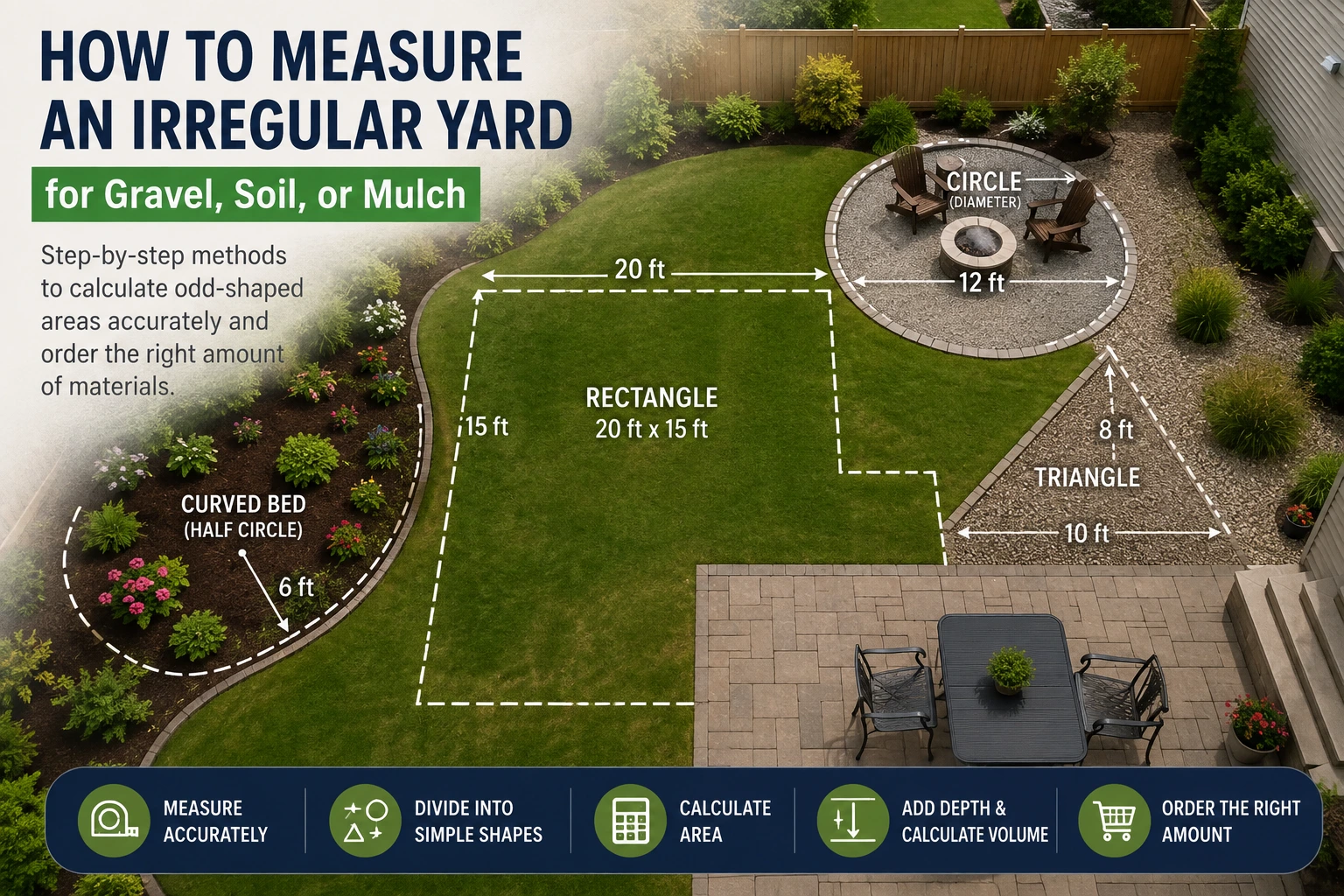
If your yard isn’t a perfect rectangle, estimating landscaping materials can feel confusing. Curved flower beds, L-shaped lawns, circular gardens, and sloped areas make it difficult to calculate how much gravel, soil, or mulch you’ll actually need.
Fortunately, you don’t need complicated surveying equipment. By breaking an irregular yard into smaller, simple shapes, you can measure the total area accurately and avoid ordering too much—or too little—material.
Whether you’re installing a gravel driveway, building raised beds, or spreading mulch around trees, this guide will show you the easiest way to measure any oddly shaped yard.
Why Measuring an Irregular Yard Matters
Ordering landscaping materials based on guesswork often leads to unnecessary expenses and project delays.
Accurate measurements help you:
- Buy the correct amount of gravel, soil, or mulch
- Reduce material waste
- Save money on deliveries
- Finish projects without running short
- Improve project planning
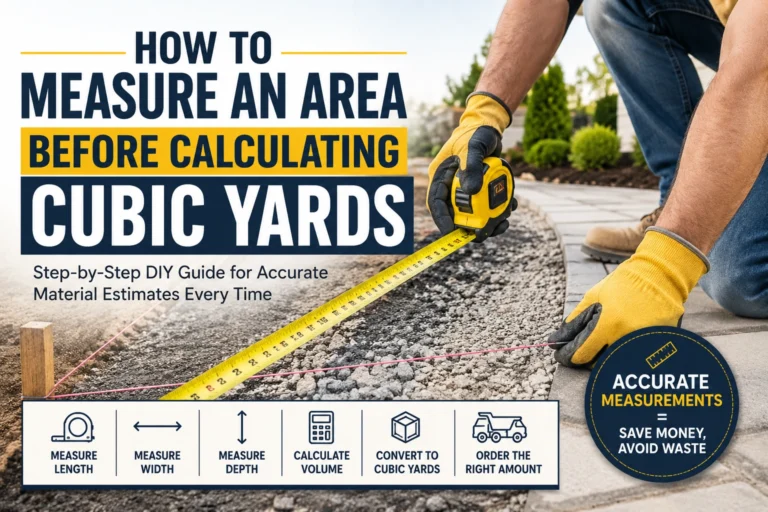
Once your measurements are complete, you can enter the dimensions into a cubic yard calculator to determine exactly how much material you’ll need.
Use our Cubic Yard Calculator to convert your measurements into cubic yards for gravel, soil, concrete, mulch, or sand.
Tools You’ll Need
Before measuring, gather a few simple tools.
- Measuring tape (50–100 ft)
- Graph paper (optional)
- Calculator
- Stakes or landscape flags
- String line
- Notebook
- Pencil
For large properties, a measuring wheel can make the process even easier.
Step 1 – Divide the Yard into Simple Shapes
The biggest mistake homeowners make is trying to measure an irregular yard all at once.
Instead, divide the area into smaller sections.
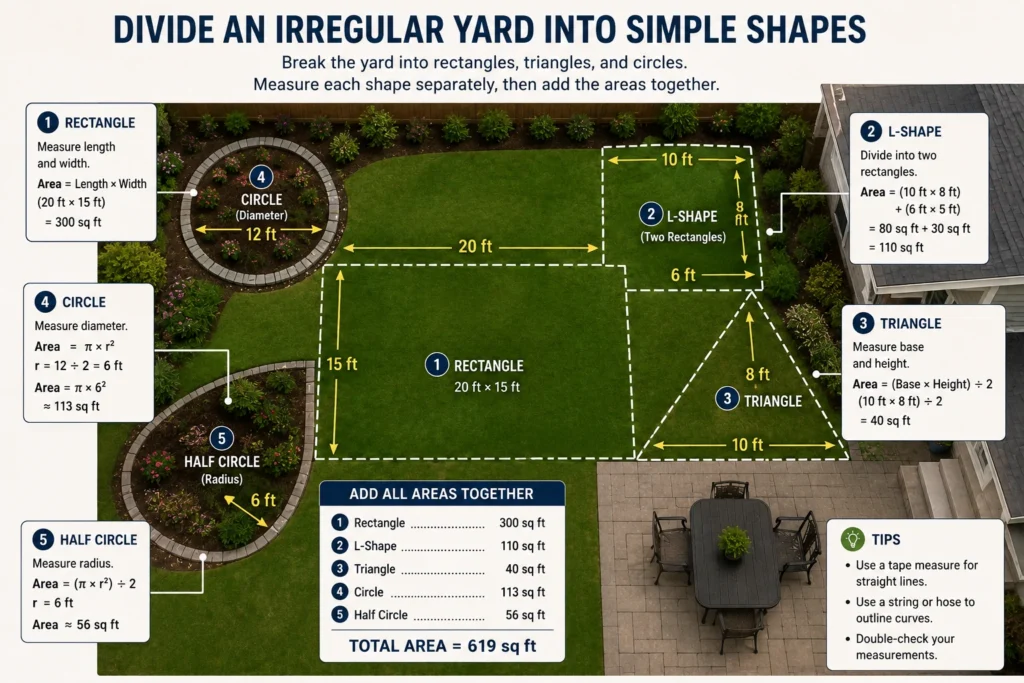
Common shapes include:
- Rectangles
- Squares
- Triangles
- Circles
- Half circles
- Trapezoids
After calculating each section separately, simply add all the areas together.
This method produces far more accurate estimates than trying to approximate the entire yard as one shape.
Step 2 – Measure Each Shape Separately
Once you’ve divided the yard into smaller sections, measure each one individually.
Rectangle
Use this formula:
Length × Width = Area
Example
- Length = 20 ft
- Width = 12 ft
Area = 240 square feet
Square
Measure one side only.
Side × Side = Area
Triangle
For triangular sections:
Base × Height ÷ 2 = Area
Example:
- Base = 10 ft
- Height = 8 ft
Area = 40 square feet
Circle
Measure the diameter first.
Radius = Diameter ÷ 2
Area = π × Radius²
Example:
- Diameter = 12 ft
- Radius = 6 ft
Area ≈ 113 square feet
Half Circle
Simply divide the circle’s area by two.
This works well for curved landscape beds and decorative garden borders.
Step 3 – Add All Areas Together
After calculating every section, combine them.
For additional information about land measurement and mapping concepts, the U.S. Geological Survey (USGS) provides helpful educational resources.
Example:
| Shape | Area |
| Rectangle | 240 sq ft |
| Triangle | 40 sq ft |
| Circle | 113 sq ft |
Total Area = 393 square feet
This total area is what you’ll use to calculate the amount of gravel, soil, or mulch required.
Step 4 – Include Material Depth
Area alone isn’t enough.
Landscaping materials are ordered by volume, not area.
Multiply the area by your desired installation depth.
Common depths include:
| Material | Typical Depth |
| Mulch | 2–3 inches |
| Decorative Gravel | 2–3 inches |
| Driveway Gravel | 4–6 inches |
| Topsoil | 4–6 inches |
| Garden Soil | 6–12 inches |
Always convert inches into feet before calculating cubic feet.
Example Project
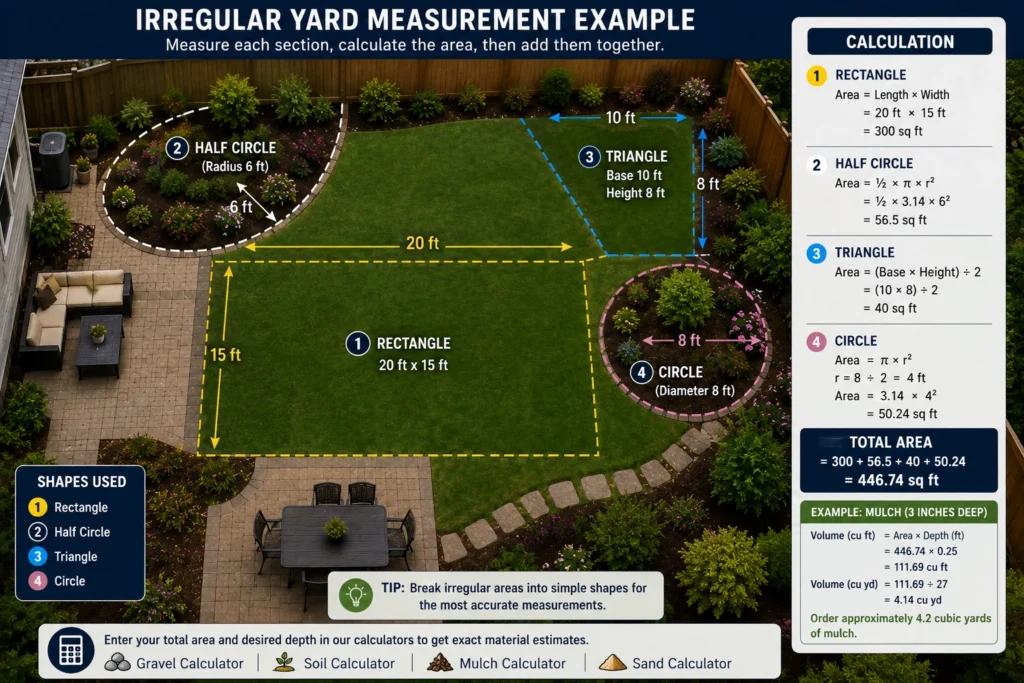
Imagine your backyard consists of:
- Rectangle: 20 × 15 ft
- Triangle: 10 × 8 ft
- Circular flower bed: Diameter 8 ft
Calculate each section
Rectangle
20 × 15 = 300 sq ft
Triangle
10 × 8 ÷ 2 = 40 sq ft
Circle
Radius = 4 ft
π × 4² ≈ 50 sq ft
Total Area
300 + 40 + 50 = 390 sq ft
If installing 3 inches (0.25 ft) of mulch:
390 × 0.25 = 97.5 cubic feet
97.5 ÷ 27 = 3.61 cubic yards
You would order approximately 3.6 cubic yards of mulch.
Common Mistakes to Avoid
Even experienced DIY homeowners make simple measurement mistakes.
Measuring curves as straight lines
Always divide curved areas into smaller circles or half circles.
Forgetting to convert inches into feet
Material depth must always be converted before calculating volume.
Example:
4 inches
NOT 4 feet
Correct:
4 ÷ 12 = 0.33 feet
Ignoring slopes
Sloped yards usually require slightly more material than completely flat surfaces.
Estimating by eye
Guessing almost always results in ordering too much—or not enough—material.
Taking measurements only takes a few extra minutes but can save significant money.
Measurement accuracy and consistent construction practices are supported by engineering standards published by ASTM International.
Measuring Different Landscaping Projects
Gravel Driveways
Measure the driving surface separately from parking pads or turnarounds.
After measuring the total area, use our Gravel Calculator to estimate exactly how many cubic yards and tons of gravel your project requires.
Raised Garden Beds
Measure each raised bed individually before combining the totals.
Curved Flower Beds
Break the bed into several circles, half circles, or triangles.
Lawn Topdressing
Measure only the areas receiving new soil rather than the entire lawn.
Mulch Around Trees
Treat each tree ring as its own circle for more accurate calculations.
Frequently Asked Questions
How do I measure an L-shaped yard?
Divide the yard into two or more rectangles. Measure each section separately, calculate the area of each rectangle, then add the results together to find the total area.
What’s the easiest way to measure a curved flower bed?
Break the curved section into circles, half circles, or several small triangles. This method provides a much more accurate estimate than measuring it as one large shape.
Should I round up my material estimate?
Yes. Most landscaping professionals recommend ordering 5–10% extra material to account for settling, compaction, uneven ground, and minor measurement errors.
How do I measure a sloped yard?
Measure the surface length rather than the horizontal distance whenever possible. Sloped areas often require slightly more material than perfectly flat ground.
Can I use Google Maps to measure my yard?
Yes. Google Maps and Google Earth provide useful area measurement tools for large properties. However, using a measuring tape usually provides better accuracy for residential landscaping projects.
How do I convert square feet into cubic yards?
First multiply the square footage by the installation depth (in feet) to get cubic feet.
Then divide by 27 to convert cubic feet into cubic yards.
What’s the best way to avoid ordering too much material?
Measure every section carefully, divide irregular areas into simple shapes, and calculate the total area before estimating material volume.
Final Thoughts
Measuring an irregular yard may seem difficult at first, but breaking the space into simple shapes makes the process surprisingly straightforward. Whether you’re planning a new gravel driveway, adding fresh topsoil, or spreading mulch around landscaping beds, accurate measurements help reduce waste, save money, and ensure your project goes smoothly.
After calculating your total area and choosing the desired material depth, you can quickly determine the required volume using the appropriate calculator.
Related Tools
- 👉 Cubic Yard Calculator – Calculate cubic yards for concrete, gravel, soil, mulch, sand, and other landscaping materials.
- 👉 Gravel Calculator – Estimate gravel volume, weight, and coverage for driveways, walkways, and landscaping projects.
- 👉 Soil Calculator – Estimate topsoil, fill dirt, and garden soil requirements for landscaping and gardening projects.
- 👉 Mulch Calculator – Calculate the amount of mulch needed for flower beds, gardens, and landscaping.
- 👉 Sand Calculator – Estimate sand volume and weight for construction, pavers, and landscaping projects.