Ottawa Sand Density: Weight, Uses & Complete Density Chart (2026 Guide)
If you’re working on a geotechnical project, laboratory soil test, or engineering calculation, knowing the Ottawa sand density is essential. Ottawa sand is one of the most commonly used standardized sands in laboratories because of its uniform particle size and consistent physical properties.
Whether you’re calculating material weight, estimating volume, or preparing laboratory samples, using the correct density value improves accuracy and helps prevent calculation errors.
In this guide, you’ll learn:
- Standard Ottawa sand density
- Dry vs wet density values
- Bulk density and unit weight
- Laboratory applications
- Weight calculations
- Frequently asked questions
Quick Answer
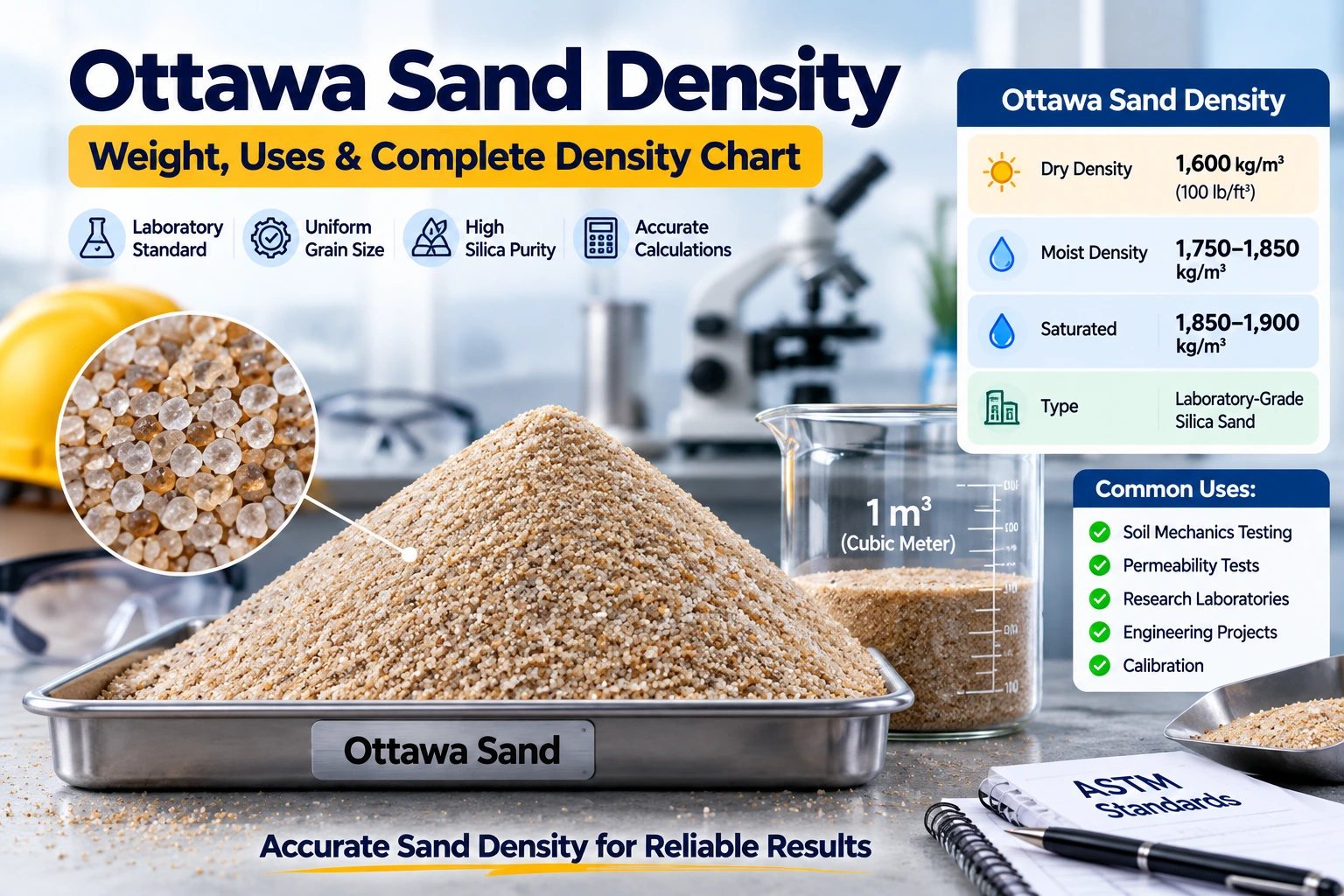
The average Ottawa sand density is approximately 1,600 kg/m³ (100 lb/ft³) when dry and loosely placed. Depending on moisture content and compaction, the density can increase to approximately 1,750–1,900 kg/m³.
What Is Ottawa Sand?
Ottawa sand is a high-purity silica sand manufactured with a carefully controlled grain size distribution. Unlike ordinary construction sand, Ottawa sand is processed to provide consistent particle size, cleanliness, and mineral composition.
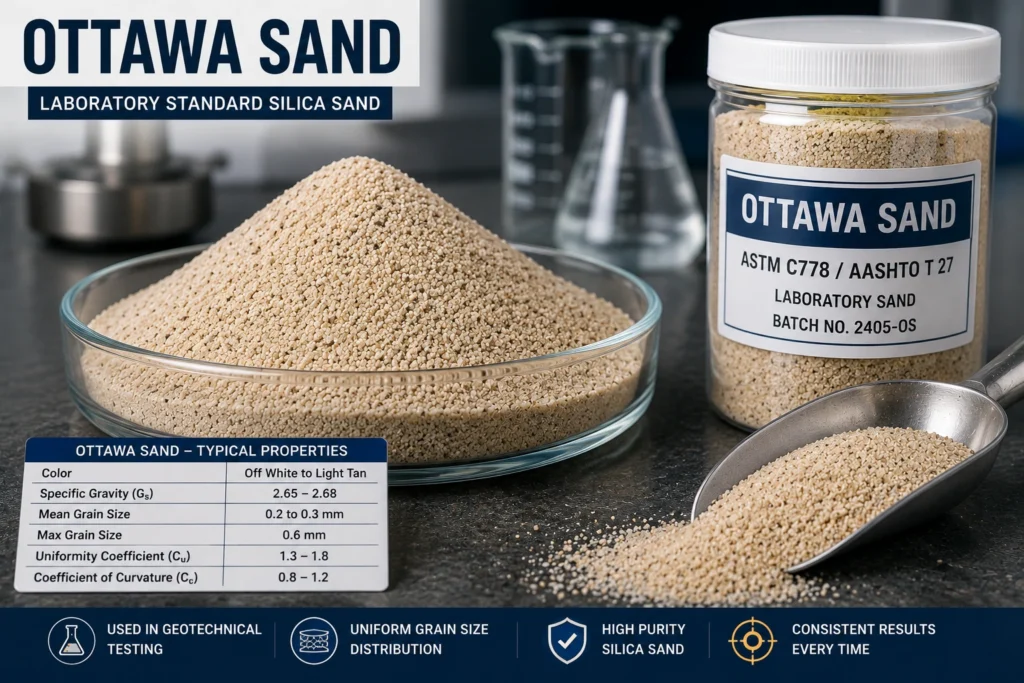
Because every batch has nearly identical physical properties, engineers and researchers use Ottawa sand as a reference material in laboratory testing.
Common applications include:
- Soil mechanics testing
- Permeability tests
- Hydraulic conductivity experiments
- Calibration of laboratory equipment
- ASTM and geotechnical standards
- Research laboratories
- University engineering programs
Its uniform characteristics make calculations much more reliable than those performed with natural construction sand.
Standard Ottawa Sand Density
The exact density depends on moisture content and compaction. However, the following values are commonly used for engineering calculations.
| Condition | Approximate Density |
| Dry Loose Ottawa Sand | 1,600 kg/m³ |
| Dry Compacted Ottawa Sand | 1,700–1,750 kg/m³ |
| Moist Ottawa Sand | 1,750–1,850 kg/m³ |
| Saturated Ottawa Sand | 1,850–1,900 kg/m³ |
These values are general engineering references. Laboratory testing should always use the required specification for the project or standard being followed.
Why Ottawa Sand Density Matters
Even small changes in density can significantly affect weight calculations, material estimates, and laboratory test results.
For example, using a dry density when the sand is saturated may underestimate the total material weight by hundreds of pounds in larger projects.
Accurate density values help improve:
- Material quantity estimates
- Laboratory accuracy
- Transportation planning
- Load calculations
- Engineering reports
- Construction quality control
Using standardized density values also makes experimental results easier to compare between different laboratories.
Dry vs Wet Ottawa Sand Density
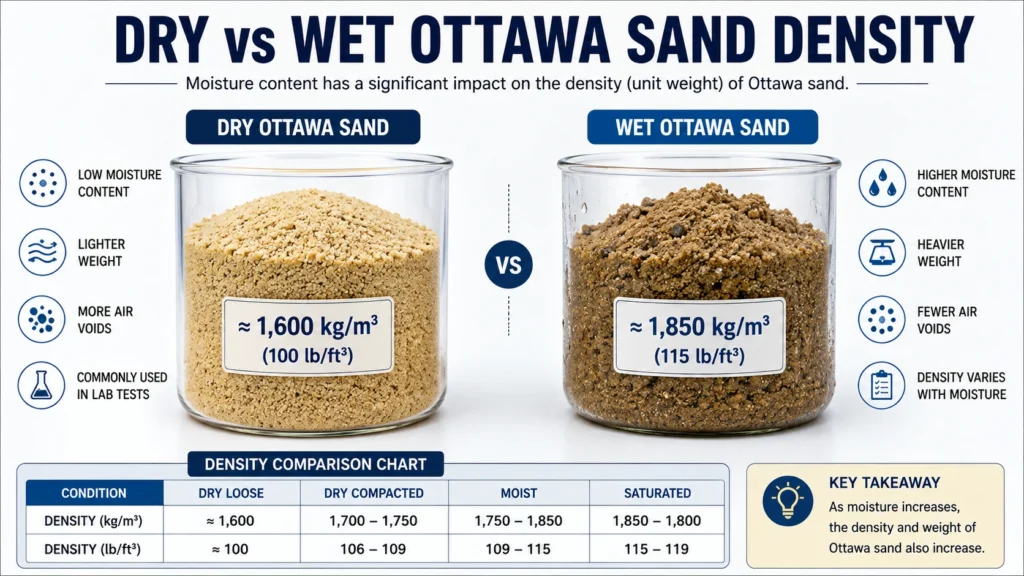
One of the biggest factors affecting Ottawa sand density is moisture content. As water fills the spaces between sand particles, the overall weight increases while the volume remains nearly the same.
Dry Ottawa Sand
Dry Ottawa sand contains very little moisture, making it the standard choice for many laboratory calibration tests. It is easier to handle and provides more consistent results during controlled experiments.
Typical dry density:
- Approximately 1,600 kg/m³
- About 100 lb/ft³
Wet Ottawa Sand
When moisture is present, the sand becomes heavier because water adds mass without significantly changing the total volume.
Typical wet density:
- 1,750–1,900 kg/m³
- 109–119 lb/ft³
Always verify whether your project requires dry density or wet density before performing calculations.
Ottawa Sand Unit Weight
Unit weight is another common engineering property used in calculations involving soil and aggregates.
Approximate values are:
| Property | Value |
| Dry Unit Weight | 100 lb/ft³ |
| Moist Unit Weight | 109–119 lb/ft³ |
| Dry Density | 1,600 kg/m³ |
| Saturated Density | Up to 1,900 kg/m³ |
These values are commonly used in engineering estimates. Individual laboratory specifications may require different values depending on the testing standard.
How to Calculate Ottawa Sand Weight
Calculating the weight of Ottawa sand is straightforward once you know its density.
Formula
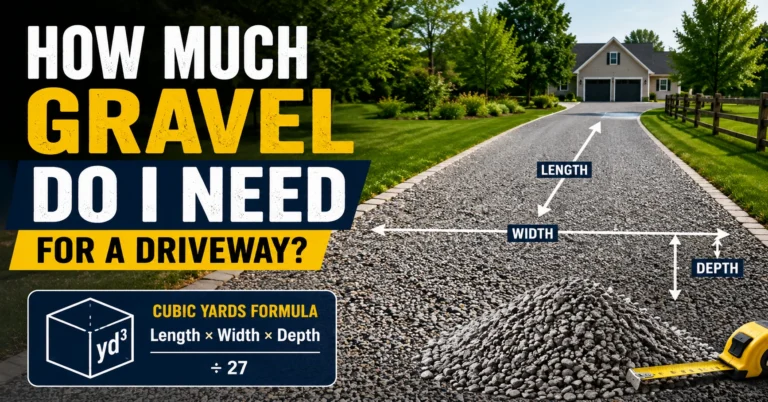
Weight = Volume × Density
Example
Suppose you have:
- Volume = 3 cubic yards
- Density = 2,700 pounds per cubic yard
Weight:
3 × 2,700 = 8,100 pounds
If your density value changes because the sand is wet or compacted, the final weight will also change.
Need help calculating volume first? Use our Sand Calculator to estimate cubic yards before converting the result into weight.
Why Engineers Prefer Ottawa Sand
Unlike ordinary construction sand, Ottawa sand offers extremely consistent physical characteristics.
Its advantages include:
- Uniform grain size
- High silica purity
- Reliable laboratory performance
- Consistent permeability
- Repeatable test results
- Standardized engineering properties
Because of these qualities, Ottawa sand is widely referenced in ASTM testing procedures and geotechnical engineering laboratories.
Ottawa Sand vs Regular Construction Sand
Although both materials are silica-based, they serve very different purposes.
| Ottawa Sand | Construction Sand |
| Laboratory-grade | General construction |
| Uniform particle size | Variable particle size |
| High purity | Mixed mineral content |
| Used for testing | Used for concrete, masonry, and fill |
| Consistent density | Density varies by source |
For engineering testing, Ottawa sand provides much more predictable results than ordinary construction sand.
Factors That Affect Ottawa Sand Density
Even standardized sand can experience small density changes depending on field conditions.
Moisture Content
Water increases the total weight of the sand.
Compaction
Mechanical compaction reduces air voids and increases density.
Particle Arrangement
The way particles settle influences bulk density.
Handling Method
Loose pouring and vibration can create different packing conditions.
Laboratory Procedure
Different ASTM or engineering standards may specify unique preparation methods before testing begins.
Understanding these factors helps produce more accurate calculations and repeatable laboratory results.
Common Mistakes When Using Ottawa Sand Density
Using the wrong density value can lead to inaccurate estimates, failed laboratory tests, or incorrect material orders. Here are the most common mistakes to avoid.
Using Wet Density Instead of Dry Density
Many engineering calculations require the dry density of Ottawa sand. Using wet density without accounting for moisture can significantly overestimate the total material weight.
Ignoring Compaction
Loose sand occupies more volume than compacted sand. If compaction is ignored, volume calculations may not match actual field conditions.
Mixing Ottawa Sand with Construction Sand
Ottawa sand is a standardized laboratory material, while construction sand varies in grain size and mineral composition. Never substitute one for the other when a project specifies Ottawa sand.
Using Generic Density Values
Different projects and laboratory standards may specify different density values. Always verify the required value before performing calculations.
Skipping Volume Calculations
Weight calculations are only accurate when the correct material volume is known.
Tip: If you need to calculate volume first, use our Cubic Yard Calculator to estimate cubic yards before converting the material to weight.
Frequently Asked Questions
What is the density of Ottawa sand?
Dry Ottawa sand typically has a density of approximately 1,600 kg/m³ (100 lb/ft³). Depending on moisture content and compaction, the density can increase to around 1,900 kg/m³.
Why is Ottawa sand used in laboratories?
Ottawa sand has a uniform grain size, high silica purity, and consistent physical properties. These characteristics make it ideal for standardized engineering and geotechnical testing.
Does moisture affect Ottawa sand density?
Yes. As moisture content increases, the weight of the sand also increases, resulting in a higher bulk density.
Is Ottawa sand the same as construction sand?
No. Ottawa sand is a laboratory-grade silica sand with controlled particle size, while construction sand varies depending on its source and intended application.
How do I calculate the weight of Ottawa sand?
Multiply the material volume by the appropriate density.
Formula:
Weight = Volume × Density
Can I use Ottawa sand density for landscaping projects?
Generally, no. Ottawa sand is primarily used for laboratory and engineering applications. Landscaping projects usually use masonry sand, fill sand, or concrete sand, each with different density values.
Final Thoughts
Understanding Ottawa sand density is essential for accurate engineering calculations, laboratory testing, and material estimation. While the commonly accepted dry density is around 1,600 kg/m³, actual values vary depending on moisture content, compaction, and testing conditions.
Whether you’re preparing laboratory samples, estimating transportation weight, or performing soil mechanics calculations, always use the density value required by your project specifications.
For estimating material quantities, start by calculating the required volume using our Cubic Yard Calculator or Sand Calculator, then apply the appropriate density to determine the total weight.