Gravel vs Crushed Stone: What’s the Difference and Which One Should You Choose?
If you’re planning a driveway, patio, garden path, drainage system, or landscaping project, you’ve probably come across two common materials: gravel and crushed stone. While many people use these terms interchangeably, they are actually different materials with unique characteristics and uses.
Choosing the wrong material can lead to poor drainage, unstable surfaces, higher maintenance costs, or unnecessary expenses. Understanding the differences before ordering can help you build a stronger, longer-lasting project while staying within budget.
In this complete guide, you’ll learn the difference between gravel vs crushed stone, where each material works best, their advantages and disadvantages, cost considerations, and how to decide which one is right for your project.
Pro Tip: Before ordering any aggregate, calculate the exact amount you need using our Gravel Calculator. Estimating the correct volume helps reduce waste, prevents costly over-ordering, and ensures your project stays on budget.
Table of Contents
- What Is Gravel?
- What Is Crushed Stone?
- Gravel vs Crushed Stone at a Glance
- Key Differences Explained
- Which Material Is Better for Driveways?
- Which Is Better for Landscaping?
- Which Performs Better for Drainage?
- Cost Comparison
- Pros and Cons
- Which Material Should You Choose?
- Frequently Asked Questions
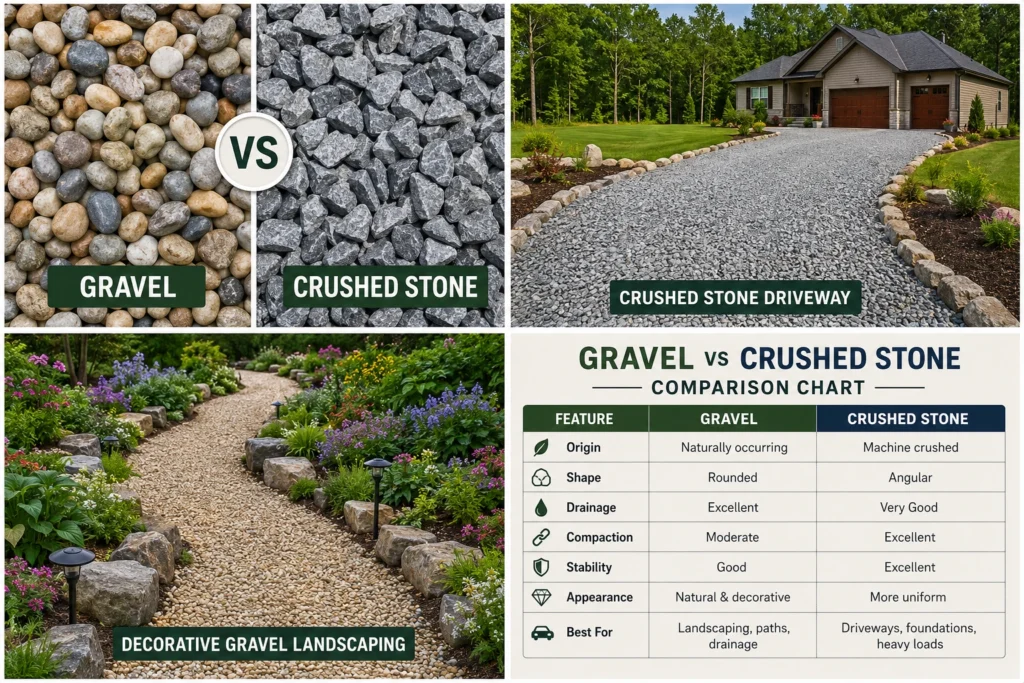
Gravel vs Crushed Stone at a Glance
| Feature | Gravel | Crushed Stone |
| Origin | Naturally weathered rock | Machine-crushed rock |
| Shape | Rounded and smooth | Angular and rough |
| Drainage | Excellent | Very Good |
| Compaction | Moderate | Excellent |
| Stability | Good | Excellent |
| Decorative Appearance | Excellent | Good |
| Best for Driveways | Good | Excellent |
| Best for Landscaping | Excellent | Good |
| Best for Heavy Loads | Fair | Excellent |
Quick Answer: If your priority is appearance and drainage, gravel is usually the better choice. If you need strength, stability, and long-term durability, crushed stone is generally the better option.
What Is Gravel?
Gravel is a naturally occurring aggregate formed over thousands of years through weathering, erosion, and the continuous movement of rocks by rivers, streams, glaciers, and other natural forces.
As rocks tumble over time, their sharp edges gradually wear away, creating the smooth, rounded stones commonly recognized as gravel.
Because of its natural formation, gravel comes in a variety of colors, textures, and sizes, making it one of the most popular landscaping materials for residential projects.
Common Characteristics of Gravel
- Naturally rounded edges
- Smooth surface
- Attractive appearance
- Excellent water drainage
- Available in multiple colors
- Comfortable to walk on
- Low installation difficulty
Gravel is commonly used for:
- Residential driveways
- Garden pathways
- Decorative landscaping
- Flower beds
- French drains
- Dry creek beds
- Around trees and shrubs
- Water features
Many homeowners choose gravel because it combines functionality with an attractive natural appearance.
What Is Crushed Stone?
Crushed stone is a manufactured aggregate produced by mechanically crushing large rocks such as limestone, granite, basalt, or trap rock into smaller pieces.
Unlike gravel, crushed stone has sharp, angular edges created during the crushing process. These irregular shapes allow the individual pieces to lock together tightly when compacted.
This interlocking ability makes crushed stone one of the most stable construction materials available for foundations, roads, patios, and driveways.
Common Characteristics of Crushed Stone
- Angular edges
- Rough texture
- Excellent compaction
- High structural strength
- Long-lasting durability
- Superior load-bearing capacity
Crushed stone is widely used for:
- Driveway bases
- Concrete slabs
- Building foundations
- Parking areas
- Retaining wall bases
- Road construction
- Paver installations
- Heavy equipment access roads
Because it compacts so well, contractors often choose crushed stone whenever a strong and stable foundation is required.
Gravel vs Crushed Stone: Key Differences
Although both materials are aggregates, their physical characteristics make them suitable for different applications.
1. Shape
The most noticeable difference is the shape of the stones.
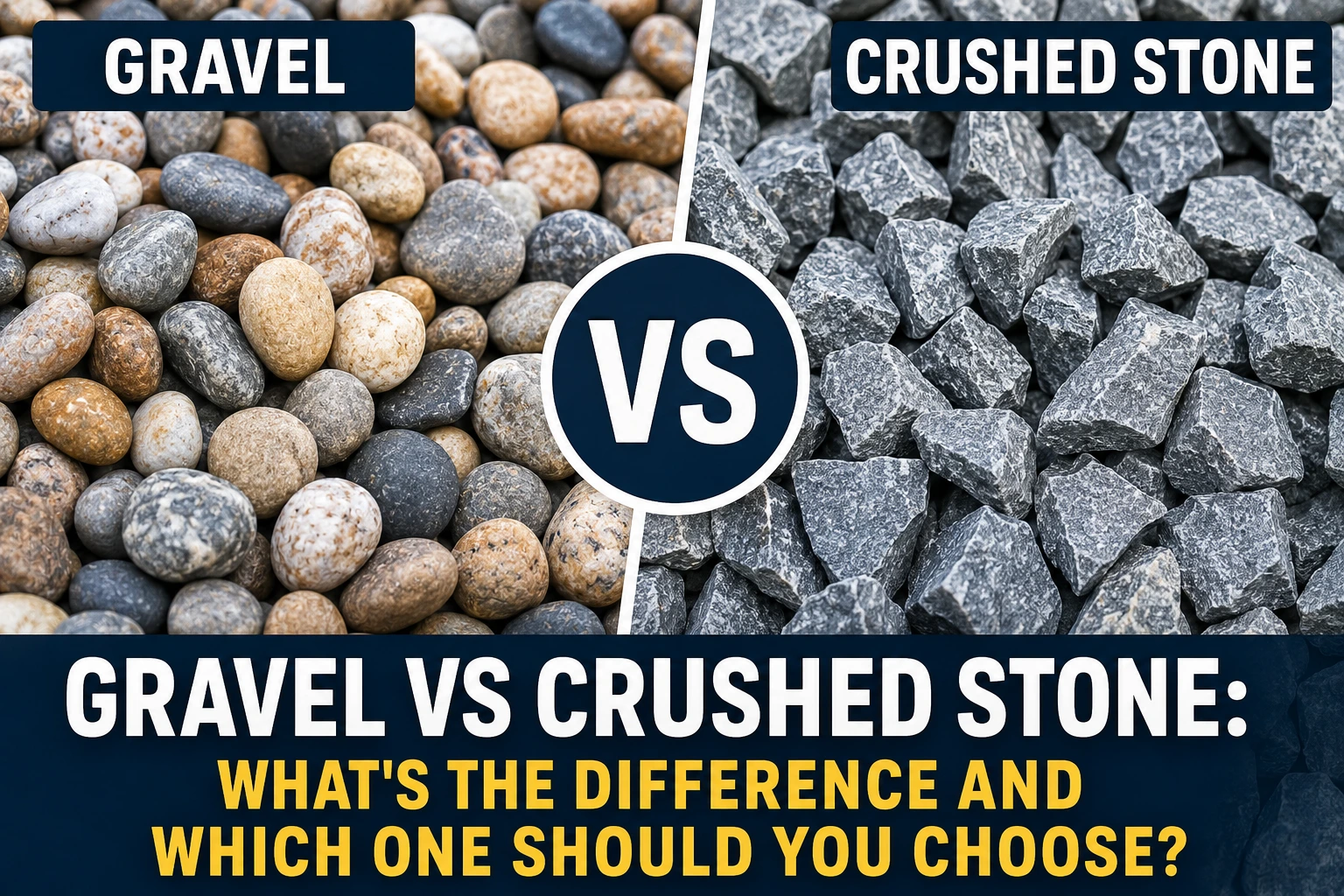
Gravel has smooth, rounded edges because it is naturally weathered over time. Crushed stone has rough, angular edges created by crushing machinery.
This single difference affects almost every aspect of how the materials perform.
2. Stability
Rounded gravel pieces tend to shift when subjected to repeated traffic.
Crushed stone locks together because of its angular shape, creating a much more stable surface for driveways, parking areas, and foundations.
If long-term stability is your top priority, crushed stone is generally the better choice.
3. Appearance
For decorative landscaping, gravel usually offers a more natural and visually appealing look.
Its smooth stones blend well with gardens, flower beds, ponds, and outdoor living spaces.
Crushed stone has a more rugged appearance that works particularly well in modern landscapes and construction projects.
4. Drainage Performance
Both materials allow water to pass through, but gravel’s rounded shape creates larger gaps between stones, allowing water to flow more freely.
This makes gravel especially effective for drainage applications such as French drains and dry creek beds.
Crushed stone also provides good drainage, especially when clean and free of fine particles, but its tighter compaction reduces the size of the spaces between individual stones.
Expert Tip
Many professional contractors use both materials together rather than choosing one over the other.
For example:
- A compacted crushed stone base provides strength and stability.
- A decorative gravel top layer improves appearance while maintaining good drainage.
This combination offers the best balance of durability and aesthetics for many residential landscaping projects.
Which Material Is Better for Driveways?
One of the most common questions homeowners ask is whether gravel or crushed stone is the better choice for a driveway. The answer depends on how the driveway will be used, your budget, and the look you want to achieve.
For most residential driveways, crushed stone is generally the better option because its angular edges lock together when compacted. This creates a firm, stable surface that can support the weight of cars, trucks, and other vehicles while reducing movement over time.
Gravel, on the other hand, has smooth, rounded stones that can shift under repeated traffic. While it still works well for many residential driveways, it may require occasional raking and replenishment to maintain an even surface.
If you’re planning a new driveway and aren’t sure how much material you’ll need, read our detailed guide on How Much Gravel Do I Need for a Driveway? It explains recommended gravel depth, common driveway sizes, and how to estimate the correct amount for your project.
Choose Crushed Stone for a Driveway If You:
- Expect regular vehicle traffic
- Want a stable surface with minimal movement
- Need a long-lasting driveway
- Live in areas with frequent rain or freeze-thaw cycles
- Want lower long-term maintenance
Choose Gravel for a Driveway If You:
- Prefer a natural, decorative appearance
- Have light residential traffic
- Want better surface drainage
- Are looking for a traditional country-style driveway
Tip: Regardless of which material you choose, installing a properly compacted base is the key to a durable driveway.
Which Material Is Better for Landscaping?
Landscaping projects often prioritize appearance just as much as functionality.
Natural gravel is available in a wide range of colors, textures, and sizes, making it one of the most versatile decorative materials for outdoor spaces. Its smooth, rounded shape creates a softer, more natural appearance that blends well with gardens and planting beds.
Crushed stone offers a cleaner, more structured look. It is commonly used in modern landscape designs where sharp edges and defined lines complement the overall style.
Gravel Is Best For:
- Garden paths
- Flower beds
- Decorative borders
- Around trees and shrubs
- Dry creek beds
- Rock gardens
Crushed Stone Is Best For:
- Modern landscape designs
- Patio foundations
- Outdoor seating areas
- Fire pit bases
- Walkways with heavy foot traffic
- Retaining wall bases
Landscaping Comparison
| Feature | Gravel | Crushed Stone |
| Decorative Appearance | ⭐⭐⭐⭐⭐ | ⭐⭐⭐⭐ |
| Modern Landscaping | ⭐⭐⭐ | ⭐⭐⭐⭐⭐ |
| Garden Paths | ⭐⭐⭐⭐⭐ | ⭐⭐⭐⭐ |
| Weed Suppression | Good | Very Good |
| Easy Installation | Excellent | Good |
| Low Maintenance | Good | Excellent |
For homeowners who want an attractive yard with a natural feel, gravel is often the preferred option. If durability and structure are more important than appearance, crushed stone is usually the better investment.
Which Material Performs Better for Drainage?
Proper drainage helps prevent standing water, erosion, and damage to landscaping or foundations.
Both gravel and crushed stone allow water to pass through, but their performance varies because of their shape.
Gravel for Drainage
Gravel’s rounded stones create larger gaps that allow water to flow quickly through the material. This makes gravel one of the best choices for drainage applications.
It is commonly used in:
- French drains
- Drainage trenches
- Dry creek beds
- Around foundation drains
- Water features
Crushed Stone for Drainage
Clean, washed crushed stone also provides excellent drainage while offering greater stability than gravel.
It works particularly well for:
- Retaining wall drainage
- Paver bases
- Foundation drainage
- Heavy-duty drainage systems
Which One Should You Choose?
If your goal is maximum water flow, gravel is usually the better choice.
If your project needs both drainage and structural support, clean crushed stone is often the better solution.
Gravel vs Crushed Stone Cost
Price is an important consideration, but it shouldn’t be the only factor when choosing between gravel and crushed stone.
Material costs vary depending on:
- Your location
- Stone type
- Supplier
- Delivery distance
- Quantity ordered
- Seasonal demand
In many parts of the United States, gravel and crushed stone have similar prices. However, transportation costs often make up a significant portion of the total expense, especially for large projects.
Buying in bulk is generally much more cost-effective than purchasing bagged material from home improvement stores.
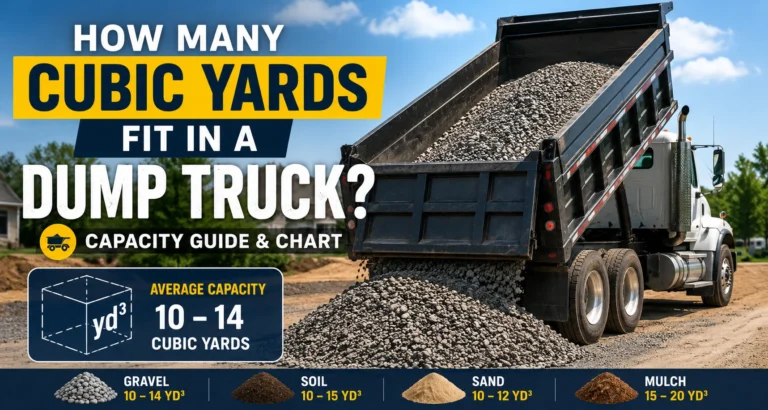
Many landscape suppliers sell gravel and crushed stone by the ton rather than by the cubic yard. If your supplier provides pricing in tons but you’ve already calculated your project in cubic yards, use our Tons to Cubic Yards Converter to quickly convert between the two units and order the correct amount of material.
Factors That Affect Cost
- Type of aggregate
- Material size
- Delivery fees
- Local availability
- Fuel prices
- Project size
When comparing costs, remember to consider maintenance. A slightly more expensive material that lasts longer may save money over the life of your project.
Planning a large project? Use our Cubic Yard Calculator to estimate the correct amount before requesting quotes from local suppliers. Accurate estimates can help reduce material waste and avoid unnecessary delivery costs.
Pros and Cons of Gravel
Pros
- Beautiful natural appearance
- Excellent drainage
- Available in many colors and sizes
- Easy to install
- Ideal for decorative landscaping
- Comfortable to walk on
Cons
- Can shift under vehicle traffic
- Requires occasional leveling
- Weed growth may occur without landscape fabric
- Less stable on slopes
Pros and Cons of Crushed Stone
Pros
- Excellent stability
- Superior compaction
- Supports heavy loads
- Lower long-term maintenance
- Ideal for driveways and foundations
- Long service life
Cons
- More industrial appearance
- Rough surface may be uncomfortable for barefoot walking
- Usually requires better site preparation during installation
Best Material for Different Projects
Choosing the right aggregate becomes much easier when you match the material to the project.
| Project | Recommended Material | Why It Works Best |
| Residential Driveway | Crushed Stone | Excellent compaction and durability |
| Garden Path | Gravel | Attractive and comfortable to walk on |
| French Drain | Gravel | Superior drainage performance |
| Patio Base | Crushed Stone | Stable foundation for pavers |
| Flower Beds | Gravel | Decorative appearance |
| Retaining Wall Base | Crushed Stone | Strong structural support |
| Dry Creek Bed | Gravel | Natural look with excellent water flow |
| Parking Area | Crushed Stone | Handles heavy vehicle loads |
Expert Recommendation
Professional landscapers often combine both materials to achieve the best results.
For example:
- Install crushed stone as the base layer to create a strong, compact foundation.
- Add a layer of decorative gravel on top for improved appearance and drainage.
This combination provides excellent durability while enhancing the overall look of the finished project.
Common Mistakes When Choosing Gravel or Crushed Stone
Even high-quality materials can perform poorly if they’re used incorrectly. Here are some of the most common mistakes homeowners and DIY enthusiasts make when selecting gravel or crushed stone.
1. Choosing Based Only on Price
The least expensive option isn’t always the best value. A cheaper material that requires frequent maintenance or replacement may cost more in the long run than a slightly more expensive but durable alternative.
Tip: Compare long-term performance, not just the initial purchase price.
2. Ignoring the Purpose of the Project
Different projects have different requirements.
For example:
- A decorative garden path benefits from natural gravel.
- A driveway needs the stability of crushed stone.
Choosing the right material for the intended use improves durability and reduces maintenance.
3. Ordering the Wrong Quantity
Many homeowners estimate material by eye, which often leads to ordering too much or too little.
Before buying materials:
- Measure the project area accurately.
- Determine the required depth.
- Calculate the volume in cubic yards.
Using an online calculator can save both time and money.
Helpful Tip: Use our Gravel Calculator to estimate exactly how many cubic yards your project requires before placing an order.
4. Forgetting About Drainage
Drainage is often overlooked until water begins pooling after heavy rain.
If your project requires fast water movement, choose a material that provides excellent drainage and install it over a properly prepared base.
5. Skipping Proper Base Preparation
Even the best aggregate won’t perform well if it’s installed on unstable ground.
A proper installation usually includes:
- Removing topsoil
- Compacting the subgrade
- Installing the appropriate base layer
- Compacting each layer before adding the next
Good preparation significantly increases the lifespan of your project.
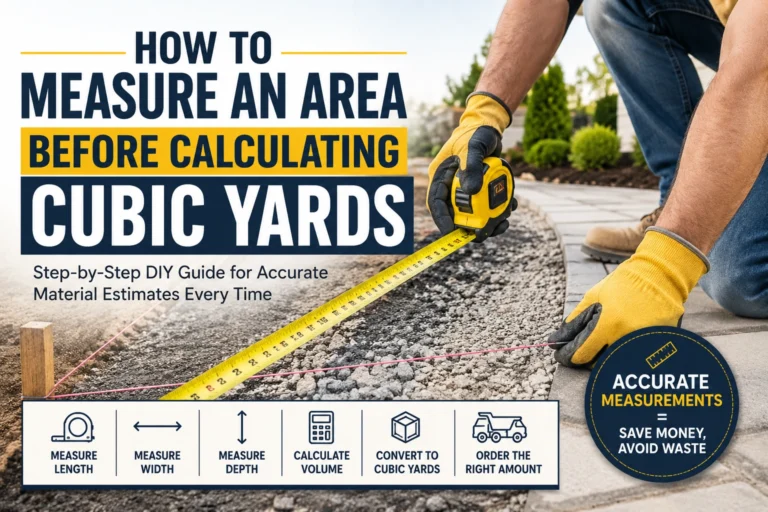
How to Calculate How Much Material You Need
Before ordering gravel or crushed stone, calculate the total volume your project requires.
Step 1: Measure the Area
Measure:
- Length
- Width
- Desired depth
Keep all measurements in the same unit (feet are commonly used).
Step 2: Calculate Cubic Feet
Use this formula:
Length × Width × Depth = Cubic Feet
Step 3: Convert to Cubic Yards
Since one cubic yard equals 27 cubic feet, divide your result by 27.
Example
Driveway Dimensions:
- Length: 40 ft
- Width: 12 ft
- Depth: 4 inches (0.33 ft)
Calculation:
40 × 12 × 0.33 = 158.4 cubic feet
158.4 ÷ 27 = 5.87 cubic yards
You’ll typically order 6 cubic yards to account for compaction and minor material loss during installation.
Frequently Asked Questions
Is crushed stone stronger than gravel?
Yes. Crushed stone has angular edges that lock together when compacted, making it stronger and more stable for driveways, foundations, and areas with heavy traffic.
Does gravel drain better than crushed stone?
Generally, yes. Gravel’s rounded shape creates larger spaces between stones, allowing water to flow more freely. This makes it an excellent choice for drainage systems and French drains.
Which is better for a driveway?
For most residential driveways, crushed stone is the preferred choice because it compacts well and resists movement under vehicle traffic.
Which material lasts longer?
Both materials are durable, but crushed stone typically requires less maintenance in high-traffic areas because it stays in place more effectively.
Is gravel cheaper than crushed stone?
Prices vary depending on location, supplier, and material type. In many regions, the price difference is small, so performance should be a bigger factor than cost.
Can I mix gravel and crushed stone?
Yes. Many contractors use crushed stone as a compacted base and finish with decorative gravel for improved appearance and drainage.
What size gravel is best for landscaping?
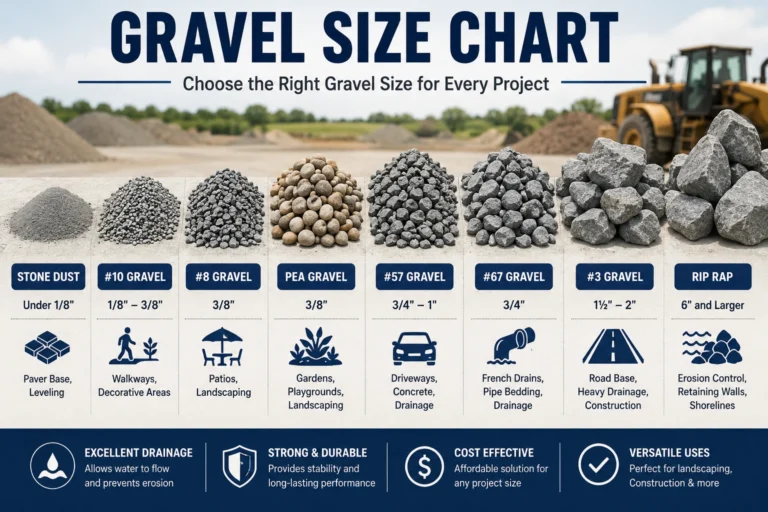
Smaller decorative gravels, such as pea gravel, are commonly used for garden paths, flower beds, and outdoor living spaces because they provide an attractive finish.
What size crushed stone is best for driveways?
For most residential driveways, medium-sized crushed stone used over a properly compacted base provides excellent stability and durability.
How do I know how much gravel to order?
Measure your project’s length, width, and depth, then calculate the required cubic yards. Online calculators provide the fastest and most accurate estimate.
Can gravel help prevent erosion?
Yes. Gravel is commonly used on slopes, drainage channels, and around foundations to reduce soil erosion and improve water management.
How We Researched This Guide
This guide is based on widely accepted construction practices, aggregate specifications, and landscaping recommendations used throughout the United States. To ensure the information is accurate and practical, we reviewed industry resources from the National Stone, Sand & Gravel Association (NSSGA), state Departments of Transportation (DOT) aggregate specifications, and educational materials published by university extension programs. These sources provide guidance on aggregate characteristics, compaction, drainage performance, and material selection for residential and commercial projects.
Because aggregate sizes, names, and specifications can vary by region, we recommend confirming material availability and grading with your local supplier before placing a large order. For the most accurate material estimate, measure your project carefully and use our Gravel Calculator to calculate the required cubic yards before purchasing.
Final Verdict
Both gravel and crushed stone are excellent materials, but the right choice depends on your project’s needs.
Choose gravel if you want a natural appearance, excellent drainage, and decorative appeal for landscaping, garden paths, or French drains.
Choose crushed stone if you need superior strength, long-term stability, and better compaction for driveways, patios, foundations, or other heavy-duty applications.
Rather than focusing only on price, consider how the material will perform over time. Selecting the right aggregate from the start can reduce maintenance, improve durability, and help your project last for many years.
Before placing your order, calculate the exact amount of material required using our Gravel Calculator. Accurate estimates help minimize waste, control costs, and ensure you purchase the right quantity the first time.